Sunday, April 19, 2015

Lindsey Mott - Weekly Artist Post

Daido Moriyama


The majority of Daido Moriyama's photographs were taken at a time before digital photography. Film is a commodity, which actually says a lot about his work. At a first glance, many seem like random street pictures, but after further inspection you being to realize how he's interacting with the setting (natural, buildings, and 2-d content), and the subjects within it. Every photograph is highly calculated and extremely intentional, although they seem effortless.

Moriyama's street photography elevates everyday scenes into something borderline surreal. I really can't put it into words. They're simultaneously mundane and exciting, typical and atypical, and they play on a tension between these two poles. It's unsettling.

Moriyama is honestly the first photographer I've profiled this semester that is using photography in the same way I hope to in my final project, and in my work in general. He is able to turn "found" places into highly composed, well thought out images.

Weekly Artist Post


These photos were taken by Ronya Galka (http://www.ronyagalka.com/#!street-photography/c1fhx). Galka mainly makes street photographs of the interesting scenes and people she sees in London. Her use of black and white brings the focus to the primary subjects and neutralizes what might otherwise be a distracting background.

Galka does an excellent job of portraying interesting relationships between people and things. Many of her images display an unusual or unexpected relationship, making the viewer really contemplate and question each image's meaning.

Each image also borders between candid and posed, leaving the viewer to decide the exact nature in which the photo was made. This gives each image an interesting mystery that leaves the viewer intrigued and wanting more. In addition, Galka's mastery over the technical aspect of her photos results in sharp and high quality photographs that are quite captivating.

Weekly Artist Post

Jasper White


Jasper White is a British photographer and these photos are from his series Tour Eiffel. Since his photos are intended to show something at a very far distance, White uses a very closed aperture to achieve a deep depth of field to make sure the tower is in focus. He doesn't photograph things that appear to be in motion, so his shutter speed could be slow. He shoots in varying times of day, so his ISO probably varies a lot. 

White's series is of an object that is photographed every single day by thousands of people. The tower is iconic and recognizable to people all over the world. By photographing it in a new way (from windows all around Paris) White is able to give it a new perspective. 

I like the idea of photographing something that everyone takes pictures of and adding something unique to it. I think this is a great example. Everything has been photographed and everything's been tried, but by creating the pictures yourself you inherently add a personal and unique element that someone else cannot. This is something I struggled with when writing my new proposal- with why I should focus on it and not someone else. 

Wednesday, April 15, 2015

Mary Pforr- Week 11 Artist post


Artist: Jeff Rawes
Photo Cred: https://www.flickr.com/photos/jeffrawes/


i. Rawes tends to use depth of field to his advantage differing the planes in the photograph. His portraits always have a super low aperture putting the focus entirely on the subject. His technique of framing is always well done and beautiful as he photographs architecture.
ii.There is always moments of "be still" in each photograph he makes. Weather it is a portrait or a landscape, there is an overall stillness with no movement. It's almost surreal. The clarity of each image allows the viewer to see almost this statement of "this is it. here" because they seem so concrete.
iii. I have always loved photographs of architecture as well as portraits, and the way Rawes makes his photographs they all seem to go side by side. The ability to make the two subjects so intertwined astounds me.

Erin Copeland- Weekly Artist post 11

Andreas Tsonidis


Andreas Tsonidis is a photographer and psychotherapist. His work is based off capturing his subjects emotionally interacting in the space they are in. He aims to capture the subjects individuality.

I was immediately drawn to his photos because the pops of bright colors surrounding his subjects. I appreciate that he draws from the subjects space they are in to capture their portrait. Being a psychotherapist and a photographer, he uses photography as a medium to bring out his subjects/patients. Not only are his photographs visually striking, looking into the peoples faces is emotionally striking as well.

Erin Copeland- Weekly artist post 10

Amy Elkins


Amy Elkins is a portrait photographer whos work is centered around portraits. She plays with the concepts of gender identity and vulnerability in her series "wallflower" Another series of her work, "Lucas", she takes portraits of Lucas from childhood into adulthood as a study of how he would present himself to the camera and how it would change as he grew up.

I like Amy Elkins work because she doesnt just want to take portraits of people, she wants to see how they present themselves in front of her camera. Some look uncomfortable, bored, and some even seem angry. I really enjoy her composition, light, and color in her photography. I chose her photos because I was immediatly drawn by her framing in the pictures and of course the light and color. But after reading about her concepts, I enjoy looking at them even more.

Ayana Chavis - Weekly Artist Post

Horst Ademeit


Ademeit uses a polaroid camera with flash. I'm not sure about settings on polaroids or if they even have those options. But in terms of aperture, I would say he is quite open. There is little to no motion blur indicating fast shutter speed (obvious with polaroid). There seems to be poor quality in the film indicating a higher ISO.

Thematically, it seems as if Ademeit is testing out his camera, finding spaces he finds interesting. It also seems as though he is taking photos for the memory, in which one can see the notes on each of the photos, indicating the date and other details.

Personally, I enjoyed the ambiguity of the photos. Considering that these photos were not for exhibiting purposes and were never to be seen by the public, I can identify with this aspect. I enjoy the idea of photography for keepsake, for memory. And, I think this is what Ademeit was doing, simple.

Tuesday, April 14, 2015

Weekly Artist Post

Tim Franco 


Franco chose to use a very old fashioned camera with a very simple kit of just two lenses for this series. Looking at the elements in each image, it is clear that he has a deep understanding of perspective as he has managed to build a dynamic yet clear visual balance in the chaotic city space. In the first image, among the chaos of the bushes, bridges and pillars, he has managed to make a stunning image by finding a perspective where there is a point of interest. This point is at the top of the hill of the bushes, where all of the bridges converge and the pillars are partly green and partly clean beige. In the second image there is an interesting element filling in each part of the image, the only open space is in the water, which has a person swimming right in the middle of the whiter-reflected water. In the third image, he has the his two subjects centered so that their heads are right above the horizon line. Also he has the subjects framed with a nice contrast between the solid archaic building on the right and the broken carts on the left. Lastly, he has the contrasting diagonal lines created by the cords and the staircase, cutting through the image from the top right to the bottom left. 

In all three images there are natural elements meeting the urban elements in an almost combative way. In the first image this is seen in the brush, bridges and pillars which meet at a total convergence where vines even start to grow up the pillar. The natural elements in the second image are the water as it extends to the mid-horizon line the and mist as it covers the bridge and city scape. Again we see a convergence with the huge ships and pillars extending from the water and the into a city scape which is blanketed by a foggy mist.  We see this again in the third image as the forest line meets the city scape in the middle of the image. Also in this image, the diagonal lines created by the cords cut through open sky as the urban staircase cuts through the green hilltop. 

I find Franco's approach to be both very captivating and telling of the social impact of China's unprecedented urban development. I think its interesting that you can see that to the people of this mega-city this may just be ordinary life as they know it. With a different perspective and upbringing, Franco is probably able to see everything with a different sense of dedicated fascination, which really shows in the enchanting nature of each image. 

Weekly Artist Post - Daniel Potes

Misha Gordin


Misha here creates in black and white similar things to what I would want to create except with color. The shots are done using silver/gelatin methods and by combining the original negatives together in a darkroom to create these stark, symbolic images of humanity. It seems like the photos he uses of humans end up being more of an aesthetic use than that of a subjective use. This makes for interesting photos in which the human body is more a sculpture than a person to be seen as subject.

The central motif in this series of images seems to be the human body and how it contrasts with space and separation from earth, as seen in the background. This is further embellished with the method and angle of photographing his human sculptures. This creates a sense of uniformness to his "subjects" which instills powerful feelings of connection.

The background of the multiple negatives seems almost like a zen garden, only disturbed by human motion and human existence. The primal nature of this series grants me much inspiration in how to model the human body and how to capture it in a way that eludes subjectivity and transcends the "person".

Weekly Artist Post - Gabe Lugo


Andreas Gursky is a world famous german photographer who makes large format photos featuring patterns, people, and places. Specifically, he focuses on a globalized society that we now live in and the patterns and uniformity that is contained within it. His photos are shot in film, and they are simply spectacular. They all make great use of light, are properly exposed, and they all have some sort of overarching pattern or theme in them. He doesn't take snapshots.

These three photos are interesting to me because they all show a mass of people working for a specific cause or unified belief. The fact that he could identify such beautiful patterns composed of just people is amazing to me. He clearly travels the world to places where he knows he will be able to take these types of shots due to some sort of event or gathering. His photos tell a story, but even if they didn't they are brilliant on their own right. 

Monday, April 13, 2015

Selasi Fynn- Weekly Artist Post

Paola Guerra 
another link 


Paola Guerra is a photographer based in Belo Horizonte, Brazil. Guerra uses light in very interesting ways in many of her photos. There is either a really good balance of light all around or there is very limited light and the little light that is used draws in the audiences attention. It's really easy to tell that Guerra spends a lot of time working with the lighting situation for her photos.

Thematically, I think Guerra's aim might have been to make interning photos of things one wouldn't normally find interesting. She wants whoever is looking at her photos to be very aware...maybe of their surroundings, or of themselves in conjunction with their emotions while looking at the photo, their surroundings, and of the photos themselves. She makes many pictures with things like stacks of paper towels, what seem like bedsheets, and things that she probably comes across during her daily routines.

Guerra does a good job of isolating things from a larger perspective and it is easy to tell that that is her intention. That is a skill that I wanted to explore/work on/develop while working on my final project. The challenge I have with portraying isolated thing from  larger group is that in my photos you can't really tell that I was trying to isolate something. It just looks like I tried to make a photo of something. I think Paola Guerra is definitely someone I will look to for inspiration when working on my final project.

Lindsey Mott - Weekly Artist Post

Stacy Kranitz


In Stacy Kranitz's series "As It Was Give(in) To Me,"she photographs her visit to central Appalachia. A number of these photographs are in darkly lit interiors, and Kranitz utilizes an external flash to light her subjects. Her pictures have a candid nature to them, even though the subject is often looking at the camera. I think she achieves this by photographing her subjects in environments that are familiar, doing action that they are familiar with.

According to her website, the series deals with "representations of realities and the inherent flaws and ruptures in constructed notions of truth". I think Appalachia is a place that almost anyone in America holds preconceived notions about. It is known as an extremely backwards place. She plays on both our perception of people who live there, as well as their perceptions of themselves, revealing that both are flawed.

Kranitz series fascinates me, because she doesn't shy away from depicting people in a way that's demeaning. She has images of snake handlers, the KKK, stripers, etc. She doesn't feel conflicted about reproducing reality the way that she's sees it. She is unapologetic, even though she admits that her own perception is flawed.

Sunday, April 12, 2015

Weekly Artist Post - Helen Westergren

Frank Rothe


Frank Rothe is a German photographer who, until recently, focused on commercial photography. With an interest in expanding his artistic practice he began to work with topics he was personally connected to. The images above are from one such series, titled "Running Through the Wind". Rothe returned to a Soviet summer camp he attended as a child and documented the experience. Being unversed in how to recognize analog v. digital photos I'm not certain how he captures his images, but each is intentional, and in this series all have been given a square frame.
Rothe's work is greatly influenced by the transience he experienced as a child. Growing up in Germany he was a photo journalist by the time he was 19. The rest followed as he constantly attempted to place himself in new cultures and learn everything about those around him. He speaks three languages, is obviously skilled behind a camera, and is shown internationally. "Running Through the Wind" is a unique project for Rothe, but one that he found much joy in. Speaking on going back to the camp he attended as a child, he found that the pace and activities were much the same. He felt a stillness that he hasn't found in other places, namely America, that was valuable to him. These images capture not only that stillness, but the joy these children feel when they have the freedom summer camp provides.
I was first drawn to Rothe's work because the images are beautiful. All together they do a great job of telling the story of this area, showing the rituals and activities that each camper engages in, but also the stillness. There are so many pensive, quite photos that show this unique pacing he speaks about in the statement attached to the work. I'm drawn to Rothe's immersion into another culture. I find it amazing that he can so effectly go into a place and not have the camera change the way people behave. I have trouble with this.

Ashley Kronsberg Weekly Artist Post

Michael Massaia 


Michael Massaia's photography revolves mainly around black and white photos; however, in some of his work color is a main component such as seen above from Transformogrify. Massaia's photography is enchanting because it constantly catches the viewer's attention and keeps its audience asking questions. In the above series, the main focus of his work is around the changing color. In each photo, your eyes bounce from color to color to take in every part of the photograph. It seems that Massaia might use a deep depth of field to capture his photos because of how detailed they are whether in color or black and white. Most of his photograph have a pure black background, meaning he must use a flash or have a direct light over head while photographing in order to achieve the depth of field necessary to get this clarity. 

Weekly Artist Post

Ray Collins 


Ray Collins is an Australian photographer and these photos are from his book Found at Sea. Collins goes to the beach every morning before dawn to create these beautiful wave pictures. He uses varying techniques to make these photos, from closed to open apertures and using very fast shutter speeds to slower shutter speeds. 

Collins can capture many different things when he makes pictures of waves. Using slower shutter speeds, he is able to show the motion of the waves and create a softer picture with the longer exposure. Using faster shutter speeds, he is able to freeze a wave and capture the individual droplets. Both effects are things that we can't normally see, making the waves seem out of this world and impossible. 

I love Collin's photos. I can't imagine how many pictures he must take to capture these beautiful images. They're a really good example of having the skills to be able to capture moments like these when they happen, instead of missing them. 


Weekly Artist Post


These photos were made by Brooklyn based photographer Paul Raphaelson. His works mainly consist of photographing urban landscapes and the cultures of urban neighborhoods. Raphaelson captures interesting images by framing some of his subjects halfway, making each frame a bit unconventional.

Raphaelson makes his images unique by making them through the filter of glass panes. Each frame is geometrically interesting in their inclusion of varying lines and angles formed by the subway structures. Additionally, the candid nature of each image brings personality and realism to Raphaelson's photography.

Raphaelson's use of the subway glass creates a new dimension to each frame, showing multiple views in individual images because of the varying reflections of light and shapes. the blueish gray colors of his images also give each frame a sort of ghostliness that's quite captivating. I think it might be interesting to do a similar project and work with reflections to create more unique images like Raphaelson. 

Wednesday, April 8, 2015

Weekly Artist Post - Helen Westergren

Tristan Hutchinson


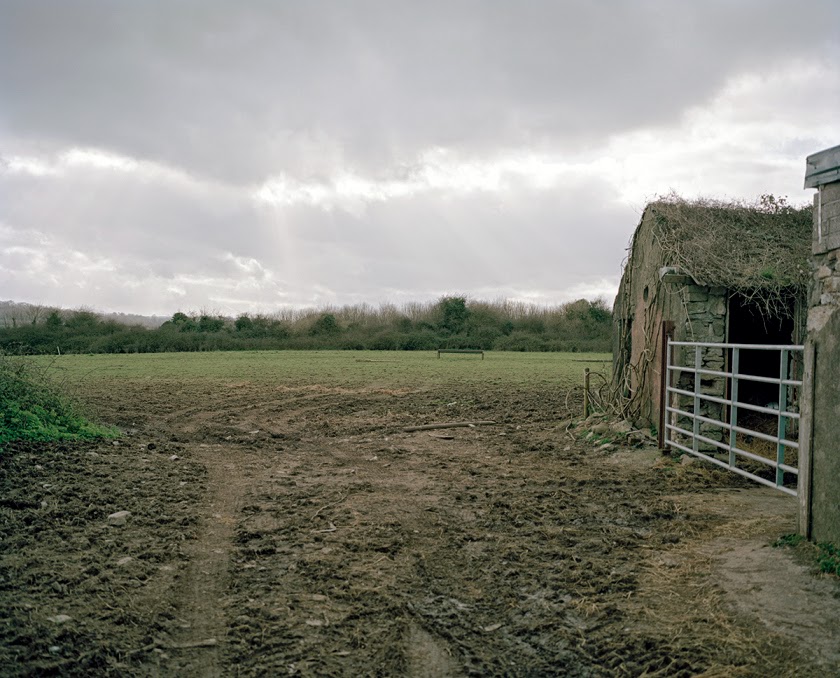
Tristan Hutchinson is a Dublin-based photographer primarily working in medium and large formats. It's hard to speak strictly to technicality because his images are not originally captured in the way we are learning in class, but his settings consistently produce well exposed images he has clearly spent time orienting. They are all edited as they should be as well, specific to the artists's taste but cohesive when viewed together.
These photos are from a series he did titled "Took Strength To Tackle These Hills". Through the series he documented two towns in Northern Ireland as they go through industrial and economic transformations. Cohb and Ringaskiddy, the two towns he is rendering, are not exactly thriving, and through his landscapes and portraiture he attempts to show this decay and hardship. As the rest of the world modernizes, these fishing and industry based towns find themselves unable to compete but still needing to make a living. Hutchinson, a native to similar areas, has inserted himself in this place so that he can truely document what it is like to be in these places.
I think Hutchinson's work is beautiful and powerful. The portraits he includes are subtle and do not reveal identity as much as they reveal people's place in this decaying land. The landscapes are wonderful but still evoke this sense of pain and unnecessary change that I'm sure is at the forefront of most inhabitant's minds. His other work is compelling in a similar way, but I enjoy how in "Took Strength to Tackle These Hills" he really committed to a subject and spent so much time developing a language to speak and communicate about this place. Pretty sure I'm going to need to experiment with large format once this class is done.