Saturday, October 26, 2013
Alexander Bergstrom - Liesa Collins
Alexander Bergstrom is a photographer based out of Sweden who primarily focuses on nude photography. In all of his photographs, there is always a subject showing off some part of their genitalia. With an amazing composition involving light, color, and subject content, Bergstrom achieves a high standard of portrait photographer. His subjects are beautiful and his technique is exquisite. Bergstrom is not very well known in the art world, but he has sure made an effort to spread his photography by means of online sites such as Flickr, Blogger, and DeviantArt.
In my opinion, Bergstrom chooses such gorgeous subjects purely to show his appreciation of the human form. He has nice lighting to show his skill in capturing the light at the right time to produce an amazing image. The subtle body part revelations in his work leave nothing to the imagination but within his act of not always showing all the body parts creates some mystery towards the subject. I appreciate the different choices in making some images in color and some in black and white because it convinces the audience how versatile he can be with his photography. Even though Alexander Bergstrom is not a mega-famous photographer, his work still deserves credit for being a strong set of portraits.
Philippe Halsman- Charlotte Laurance
Philippe Halsman was born in Latvia in 1906 but his photography career began in Paris, France. He is a famous portrait photographer known for photographing artists, celebrities, politicians and other experimental subjects. Halsman makes images using a twin-lens reflex camera that he designed himself.
Halsman was named one of the World's Ten Greatest Photographers in 1958 by his colleagues. From 1971-76 Halsman taught a seminar entitled "Psychological Portraiture" at The New School. Some of his most iconic images come from his subjects at the end of their shoot. Halsman would ask them to jump in front of the camera with all their energy and silly-ness they could muster.
“Every face I see seems to hide – and sometimes fleetingly to reveal – the mystery of another human being. Capturing this revelation became the goal and passion of my life.”
Tuesday, October 22, 2013
Gene Kim: Jimmy Nelson
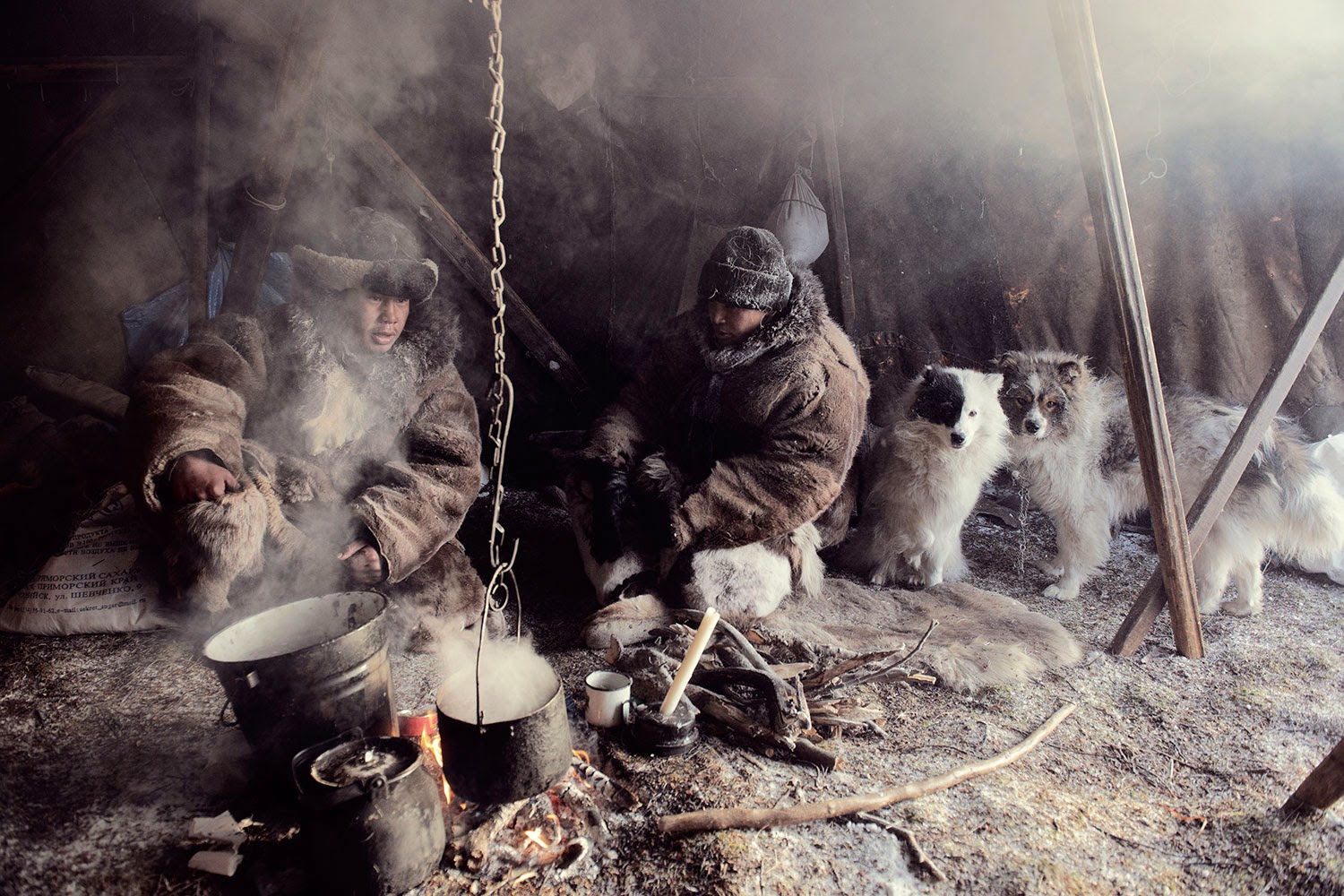
Upon visiting Tibet in 1987 for a whole year and coming back with a series of photographs captured in the isolated region, in which Jimmy Nelson won much international acclaim for. Starting 1997, Nelson began on his journey in visiting various corners of the world documenting the indigenous folks of the places he traveled to. He states that we have much to learn from the humanity of these people whose values are often surrounded by family, camaraderie, and honesty, "to see, to understand and to remember before they pass away."
Nelson's works exhibit beautiful combination of capturing the surrounding scenery of the shown areas with the indigenous people that inhabit the land, as they feed off each other. As the Chukchi of the Arctic are born and raised in the winter, they become one with the cold and found a way to live that way for thousands of years. A Masaai warrior looks onto the plains of Kenya that are rapidly being taken away by industralization, the darkness glooming over the grass. The Mustang monks pray in unison as the light touches them in reply, illuminating the room while setting a line in balance of the frame on the floor.
http://www.beforethey.com/#jimmy-nelson
Richard Knox Robinson
So this week I've decided to go with a familiar name and face. Richard Knox Robinson is currently a professional photographer, filmmaker, and instructor at VCU. He has had photos shown in Smithsonian Magazine, The Washington Post, and even displayed on the Discovery Channel. In addition, his experimental documentary entitled The Beekeepers was shown at the Sundance Film Festival. He his currently working on a new project called Song of the Cicadas.
His editorial work is very interesting. I love the contrast he captures in the photos as well as the color palette he utilizes. His black and white editorials, especially the Life in an AIDS clinic contains beautiful contrasting light. More of his work, including various projects, can be found on his website:
http://www.robinsonphoto.com/index.html
His editorial work is very interesting. I love the contrast he captures in the photos as well as the color palette he utilizes. His black and white editorials, especially the Life in an AIDS clinic contains beautiful contrasting light. More of his work, including various projects, can be found on his website:
http://www.robinsonphoto.com/index.html
Sunday, October 20, 2013
Lisette Model: Jessica Aicholtz
She was born in Austria Hungry, studying music. However, after her father passed away she moved to paris and decided to study visual art. Model credited most of her knowledge of photography to portrait photographer Rogi Andre.
She is most well known for her portraits on a promenade in Nice. They are candid shots that are taken close up and cropped. They expose the locals by featuring their vanity, insecurity, and loneliness.
Towards the end of her career she began teaching at the Sans Francisco Institute of the Arts.
She is most well known for her portraits on a promenade in Nice. They are candid shots that are taken close up and cropped. They expose the locals by featuring their vanity, insecurity, and loneliness.
Towards the end of her career she began teaching at the Sans Francisco Institute of the Arts.
Philip-Lorca diCorcia - Hannah Nees
After studying at the School of the Museum of Fine Arts in Boston, Philip-Lorca diCorcia received his Master of Fine Arts degree for photography from Yale University in 1979. Currently living in New York as a professor at Yale, diCorcia stands as a master of light photography. He has what is called a 'cinematic approach to photography'. By taking Polaroid test shots, diCorcia thinks like a film director by working the scene before shooting the final. Many think that his shots are candid, though they are all set up. By photographing his family and friends, he found his artistic style. diCorcia is famous for setting up and planning every aspect of every photograph he takes. He uses different light sources (standing alone as well as mixed together) to highlight on the strangeness of the world.
One of the themes that diCorcia touches on is the unseen versus the closed world, which is seen in the strangeness of his photographs. Though you may feel like you could have been in that moment when analyzing his photos, you'll soon realize that everything in the photo was planned long before he pressed the shutter. In the 1980's-90's, diCorcia explored a sketchy section of the Santa Monica Boulevard in search for different types of people to photograph, which led to one of his main themes: people.
Sarah Retchin--Hannah Price
Price, a 2009 graduate of Rochester Institute for Technology
is originally from Fort Collins, Colorado and is primarily photographically
interested in American minorities. Her series, City
of Brotherly Love, features portraits of men in Philadelphia
captured just moments after they harassed her on the street. After moving to
Philadelphia in 2009, a much larger city than her hometown, she experienced
getting catcalled, something that she hadn’t had to deal with in Colorado.
Instead of shying away from the attention, she turned it right back on her
aggressors with her lens.
Because there isn’t much context provided in her photos, they leave a
lot to the viewer’s imagination. For me, it’s difficult to tell if the stories
enlighten photography that can stand on its own, or if they're just a
crutch for some sociological study. I am, however, hooked by the story, and I
think the photos construct a visual, which is compelling as a whole.
Price says that taking photographs of the "catcallers" was a
way to address and confront the people who catcalled her. "I'm in the
photograph, but I'm not. Just turning the photograph on them kind of gives them
a feel of what it's like to be in a vulnerable position — it's just a different
dynamic," Price says. "But it's just another way of dealing with the
experience, of trying to understand it."
Piotr Zgodziński- Allison Bills
Zgodzinski mostly does pro fashion & beauty in the "real world", but also does a myriad amount of side work, just enjoy photography as a relaxing hobby. His sets on his website are ordered camera-wise, only to "show you that the camera doesn't really matter". The photos are usually revolving around people, as he sees beauty in body parts and expressions. Most of his photographs are centered around a certain subject, while the background is usually revolving around light. I find what he chooses to include in the photograph is usually the most interesting part of each one; I am often intrigued by the simplicity of the composition.
Taylor Stevenson: Rosie Hardie
What captured my interest in Rosie Hardie's work was due to the way she was discovered. Rosie Hardie started taking photos when she was 16 and posted her work on Flickr just so show her growth and love for photography; when one day her life changed. It changed when Maroon 5 had discovered her work when looking for inspiration for there Hands Alls Over album cover.
Rosie Hardie is a 19 year old with a great since of creativity. Hardie takes a fresh perspective to a seemingly simple portrait. She mostly takes her subjects personality into perspective when she shoots them. She likes to stay true to her subjects which makes them seem very comfortable in there surroundings. This also makes it seem more realistic because the subjects look as if they belong within each shot. I enjoy her work because she creates the set that the subject is placed in, she is in control of each shot which is something that I struggle with.
Her work is fashion based but does not rely on the cliche fashion photography. She likes to have meaning and create a story behind her work, she doesn't just want to focus on the main subject but create a evenly interesting background. She also doesn't like to do much post-editing if she can avoid it, she likes to take her lighting and cropping in the camera so when she gets onto photoshop she can simply just add her artistic additions.
E.J. Bellocq- Shannon Roulet
E.J. Bellocq was a photographer in 1930's New Orleans. Most famous for his shots of opium dens in Storyville, I was drawn to his more personal work which features mostly portraits of female prostitutes from a rede light district . He used a 8x10" film camera mostly. I found it very interesting that this series of portraits was pretty much a secret project and wasn't really discovered till it surfaced accidentally in the 1970's. They were all printed from glass negative plates. I really love the personal a relaxed style of portraiture. None of the pictures seem forced and that feeling really resonates in each one.
I find his approach to these photographs of women, especially the nudes, are very unique for the time they came out of. They are far from exploiting or objectifying the women, and instead it is a literal study of the human form. I think in even the most sexual(imagery wise) of the photos, there isn't an overbearing sexual connotation to it. I actually feel like there is more of a naivety and innocence to the collective work. Personally, I think Bellocq was going somewhere with this series and I would have loved to see more. I think the creepy, secretive nature of the photographs adds a lot of context in my eyes, but even just on an aesthetic level, these portraits are brilliant.
Robert Frank - Natalie Kohlhepp
Robert Frank is a hugely
important figure in American photography and film. He immigrated from
Switzerland to America in 1947 and his most notable work, the 1958 book titled The Americans was a book of nuanced
moments and a strangely compelling view of America from an outsider’s
perspective. This book, I think, really gave people a view of themselves in a
way no one had ever captured before. Frank later expanded into film and video
and experimented with manipulating photographs and photomontage.
My first time being exposed (no pun intended) to black and white film
photography was looking through my Dad’s copy of The Americans in middle school and it still hits a cord in me today
when I look through it. His work makes me less afraid of taking a bad
photograph, and instead inspires me to travel, to be impulsive, and to just see the people around me. On the
flipside of that, when I think about his work when I am walking around with my
analog camera, I feel the need to find these perfect scenes without disturbing
anything, or posing shots, and then my photographing experience becomes this
tense hunt for the perfect moment.
Liesa Collins - Joseph Minek
Joseph Minek was a graduate student at VCUarts last year, and I am very grateful to have known him. His work includes various chemical and physical destruction of an already existing photograph. Most of his pieces are metallic chromogenic prints (which is the name of a process where silver image of each layer is first developed and there are layered dyes throughout the print, the process subsequently forms dyes only in those areas where silver is present). His work is labor intensive and very different from anything I have ever seen. Minek has taken the photography aspect out of the image, and left more of a sculpture and print making theme into it.
Joseph Minek is very interested in the way that photographic material can be deconstructed and then reconstructed back again. He is interest in the chemical process that makes up an image. He calls his breaking down of its material structure his "experiments", which is only fitting due to all the scientific processes he goes through. He pays homage to the first inventors of photographs by breaking down the process they discovered so many years ago. Minek is all about two specific things: the process and the production. Within trying to avoid "happy accidents" Minek was able to produce these amazing and in-depth destruction/reconstruction pieces that were so successful that he got his thesis approved just last year. Nice job Joe!
Joyce Tenneson- Virginia
Joyce is an American, fine art photographer. Her camera of
choice is a 20x24 Polaroid. Her photographs have a soft, surreal feel to them. They are relatively simple as she usually only focuses on one to two
subjects against a static background. Her subjects tend to be slightly less
than sharp- and she uses a lighting technique that causes them to glow. The photographs in her collections possess a painterly quality: She also uses de-saturated colors in
her photos, matching and contrasting them with the skin tones and clothing of
her subjects. Using a slight blur, Joyce creates a seemingly ephemeral being
from her imagination -leaving us viewers completely dazzled.
The subjects of Joyce’s work are primarily women- most only partially clothed. With the use of her distinct
technique, she frames them as mysterious, delicate creations. Another reoccurring
subject in her work are flowers. She beautifies them with her lighting and
coloring. Her flowers, however, are much
sharper and less technically tampered with than her portraits. I think that
Joyce is pushing the boundaries of photography and going places that have not
been explored yet- by trying to incorporate the feelings of other mediums in
her work.
What did we need for Tuesdays Critique?
I was absent on Tuesday and I wasn't sure what exactly did Shane want us to have for it, other then what is stated on the projects sheet. If anyone can help THANK YOU (:
Abbey Reddington-- Jonathan Lovekin
My journey upon finding the photographer for this weeks blog post came from my hour procrastination on Pinterest, drooling over and "pinning" meals I'll never actually be able to recreate. This got me thinking, what tricks the viewer to drool over these fictional feast? The answer came as a shock to me; the same photographic tricks used by portraitists and landscape photographers. Jonathan Lovekin, photographer and author of multiple cookbooks, showed me the beauty and art behind food photography.
When browsing through his portfolio, I realized that Lovekin's focus varied greatly from not only food but landscapes. His style, however, remains fluid. Beautiful, light shades of color dance across the image. Soft light graces the subject, and avoids taking away way Lovekin's purpose of the photograph. He understands composition and and how to frame the scene perfectly. He is challenged with time restraints similar to a full time landscape photographer trying to get an image during a certain hour, with the right shadows. Lovekin is challenged by the race against the clock, preserving the steaming food before him that is minutes away from being cold and ordinary. This week taught me to never overlook art, for it is everywhere.
Friday, October 18, 2013
Charlotte Laurance-Stephen Shore
Stephen Shore is an american photographer who is famous for his use of color and also banal images. Banal images lack originality and are to be obvious and slightly boring. However, this technique really drew me to his work, so much that I'm choosing to emulate it for my darkroom class. I feel that Shore's images are simple enough to find beauty in them, which is what I want to create. He started as a self taught photographer with a film camera, shooting only in black and white. Shore's methods of creating photographs included making cross country trips of America and Canada in order to find landscapes that fit into his style. While on these journey's, Shore decided that he would start photographing these places in color, put them in a book, call it Uncommon Places, and have it be used as a 'color photographers bible'.
Subscribe to:
Posts (Atom)


.jpg)