Thursday, September 27, 2018

Ruben Pagan - Jesse Rieser - The Changing Landscape of American Retail


This project by Jesse Rieser is one of my favorite ones yet. The way he composes each frame is so carefully envisioned and made by taking into account the manner in which the viewer's eyes travel across every individual image. His use of soft, pastel colors helps convey a sentimentally reminiscent view. He also pays close attention to each geometric plane and makes sure they're evenly aligned across the frame. Altogether, his technical decisions work together to really give the viewer a sense of a not so distant past, that is already beginning to be abandoned.

The artist's conceptual intentions are clear, he wishes to portray a sense of being able to look into the past and peeing into the future without necessarily showing the future in his images. The future is implied by how life is around us today. Technology is evolving and we're becoming ever so consumed by all of the new changes in our society. Rieser isn't trying to go against change though, he is simply shining a light on times of his younger years in a reminiscent manner. He mentions some of the memories he has had in retail stores in the mall of the area in which he grew up in. In those experiences, friends socialize and meet up in malls, and unintentionally develop face-to-face social skills with strangers. Rieser is trying to show how although we haven't completely lost these times, they're approaching a not-so-distant end.

Rieser's intentions make me feel reminiscent without a doubt. Each image makes me feel slightly different and give me different memories about this particular past. Although I was born in 98', I remember a time when I was younger when internet communication, social media, and online shopping weren't yet relevant. Every mall would be thriving on any given day of the week. You could go and see many different people, some not even there for the purpose of shopping. They were hangout spots for teens after school and places where people would go for lunch. These days, when I drive past a closed Toys R Us, it reminds me of being in Puerto Rico with my grandparents and my little brother, and my brother begging for stuffed animals. He late puked in one of the isles due to eating too much candy. Memories like these, even though they may not have anything to do with the location, are directly associated with them when I think of those moments.

Wednesday, September 26, 2018

Mariela Gavino - Michael Mergen - Post 5


1600 Pennsylvania Ave by Michael Mergen

For this week's blog post, I decided to do an artist/ series that I did not necessarily really like. I felt that Michael Mergen's technical choices in his series 1600 Pennsylvania Ave made the landscapes feel too stagnant. It may have been the artist's intentions, but there was nothing in the photos that captured me or kept me there. I also felt that his exposures made the photos feel flat. The lighting and contrast were not very different in range. Not to mention most of the subjects are all centered in the composition, which can be successful but I felt that Mergen could have had more range in his technicalities.

Conceptually, I think Mergen is a little more successful. Before reading about the series, I had only seen the name 1600 Pennsylvania Ave, which immediately put the white house into my head.  With this idea in mind, I didn't quite get the connection between the photos and the White House. I kept trying to think of similarities. I had come to the conclusion that Mergen was just displaying photos of mundane American streets apart from the American symbol of the White House.  This was maybe done to show disconnect between the government and the people. After reading the statement about the series, my assumption about the disconnect was pretty close. Mergen was capturing places in America that shared the same address as the White House to show the stark difference between them.

Personally, I felt that Mergen could have pushed the photos a little further. I felt that his concept was not communicated very well through the photos. If I had seen these photos, without any context or series title, they would not hold any weight or interest to me. I am interested in the concept of the address but I think its drama and isolation could have been translated better. The title or explanation should not be the only thing that makes the photos successful.

Peter Franck - Nicole Plummer Post 4


Peter Franck


            Right off the bat, I was drawn to the sci-fi appearance of the first image. Being a huge fan of conceptual/surrealist/sci-fi art I had to know what Peter’s process was. Interestingly, he takes photos from the early 1900’s and scans them in for some fun photo shopping.  I fell in love with the idea of “futurizing ” old photographs. He also intends to create wet plates of his images and maybe even work them further from that point. All of this considered, I enjoy most if not all his technical choices form old black and white photos to digital manipulation and reprinting.

            Conceptually, they seem relatively straightforward to me. Although they are primarily abstracted a bit, the concept stays in a future setting with an old school film appearance. Reading a bit of his dialogue about his childhood, I started to consider a possible deeper meaning. He was the only one in his family who wanted to endlessly look through “old holiday pictures” as he stated. His concept could reflect the fact he’s in a modern era with a vintage heart. Essentially, I imagine his passion lies within the process of carefully selecting and capturing photos, but unfortunately for him existing within this day and age, quantity is a high demand in certain situations. Thus, taking old photos and manipulating them is his way of getting the best of both worlds.

            Similarly, I myself enjoy photo manipulation, and greatly appreciate when methodical time and thought are evident within a photo. Lastly, I believe the greatest take-away I get from his series is manipulating premade photos. In the past, I typically would stage a situation presumptuously for post-manipulation. Because of this body of work, I am intrigued with the idea of shooting photos first, and picking some afterwards to manipulate. Not to say my original planning method is no longer valuable or something I no longer enjoy, only that, he has encouraged me to expand and try a new work flow.

Sunday, September 23, 2018

Marlena Artis - Tania Franco Klein post 5


1) Which of the artist's many technical choices are of interest to you and why?

First of all, her entire series, "Our Life in the Shadows", contains a variety of vivid colors combined with different lightings and harsh shadows. I absolutely adore the balance between the colors, lights, and shadows that Klein creates. Klein has a very simple composition throughout this series, most of her photos do not have many different subjects or distractions. She relies mainly on the use of colors, lights, and shadows. I really like this concept because many photographers rely on what their subjects are rather than utilizing other aspects of photography to create a shot.

2) What do you believe are the artist's conceptual and/or thematic intentions?

I believe Klein is trying to express melancholy and exhaustion throughout this series. Her shots are of mainly of one person alone, either standing or laying down. Some are of herself as well. Her still life shots are of objects that seem to be carelessly put away or left out. These inanimate objects seem to all be waiting for their owner to come back and tend to them, since it looks like the owner got up to tend to other matters. It seems that Klein is expressing how we as people constantly live an exhausted and sad life; always nonstop working on something to achieve a higher end goal. Yet we remain depressed, anxious, and tired from never fully getting to where we want to be. Therefore her reasoning for naming this series, "Our Life in the Shadows", since nobody sees the struggle we all personally go through - physically, emotionally, and/or mentally.

3) How do you personally respond to these choices and intentions?

I really love this series and each one of her photos are perfectly composed in my opinion. I truly admire her use of lighting and shadows along with her vivid choice of colors. Looking at each of her photos lets me think of taking photographs in a different way. Rather than creating/picking my subject and framing it myself, I feel like I should also let lighting and color be a way to determine my subject. Personally I really like her idea and concept for this series, it's easily relatable to many other people. We all deal with depression, anxiety, etc; at a certain point in our lives and we usually keep it to ourselves. Klein tells a relatable story through this series, shooting the scenes that nobody really sees.

Friday, September 21, 2018

Discoveries-Madeline Edwards

 I found if you lengthen the time of exposure and flip between different vantage points the two different vantage points become superimposed on each other.
 I found if you get really close to an object and completely unfocus the shot the camera can capture abstract photos of what appears to be pure color. This is a close up of my skin. I'm fascinated by abstract photography because when I think of photography I think of realism.
 I found you can adjust the zoom while the camera is shooting.
 I discovered that with a high shutter speed you can capture the details of flowing water. 
Adjusting for a slow shutter speed I found you can paint with light in a strange, abstract way. Here the light is very dim due to the small aperture.

I Am Actually Very Scared to Post These-MadelineEdwards


I am apparently terrified to show gross images of my personal bodily functions. No kidding my heart is pounding as I upload these. I am scared of making gross art or examining my body too closely and showing off all of its disgusting features.

Schuyler VanSyckle - 5 Discoveries

1. Normally I can mess around with either the shutter speed, ISO, or aperture to get the perfect lighting for a picture. I've learned and discovered that it takes shutter speed, ISO, and aperture to get the perfect lighting for night time/dark pictures. I am not the best at taking pictures in the dark and I am trying to work on figuring out what shutter speed and aperture to use that makes the image turn out light enough without making it completely grainy. 

2. I discovered that by just changing the shutter speed, the lightning of the picture can drastically change. I knew that shutter speed had a part of affecting the amount of light that a camera let in but I never knew that it would affect it this drastically. 

3. I discovered that by just changing the aperture, the lightning of the picture can drastically change as well as changing just the shutter speed. 
4. Both aperture and shutter speed can change the lightning of the photo by themselves. The only difference between the two is that shutter speed can also affect motion and aperture can also affect depth of field. I just never knew that they both had something in common. I always thought they were completely different tools. 

5. I never realized how much the zoom on the lens can affect your picture. I discovered that zooming in all the way and moving your body makes the picture look a lot better than it would by moving your body with the zoom all the way out. By zooming in and moving your body it makes the image lay flat (as shown in image 1). By zooming out and moving your body it makes the image look fish eyed (as shown in image 2). 


Schuyler VanSyckle - Megan Jacobs - Post 4

 © Megan Jacobs     © Megan Jacobs
 © Megan Jacobs     © Megan Jacobs
 © Megan Jacobs     © Megan Jacobs

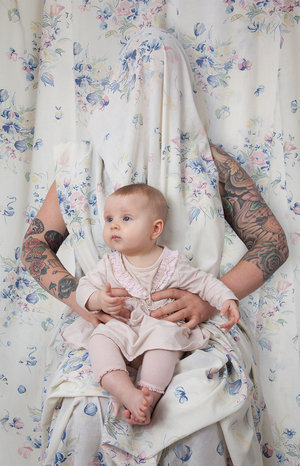
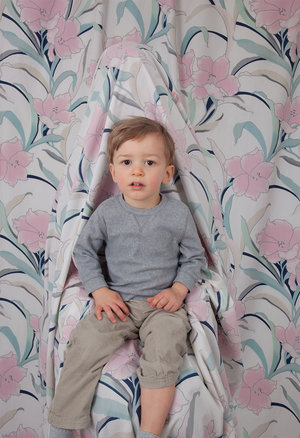
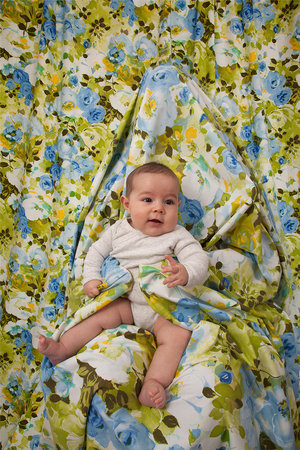
"Hidden Mothers"---Photos By Megan Jacobs 

1. Which of the artists many technical choices are of interest to you and why?

Megan's choice to take pictures of children while not having the mothers shown in the photo but instead using them as props is very intriguing to me. Using mothers to hold their children still while they get a photograph of them is something I've never seen done before. 

2. What do you believe are the artists conceptual and/or thematic intentions?

After reading the artist description for these photographs I realize that her intentions were to show the way that photos of children used to be taken when cameras exposure times were long. Before reading the description I believed that the artist intentions for these photographs were to show the new life of the mother. "Mothers with their heart outside their bodies" show that once a woman becomes a mother they put all their heart and soul into their kids and these images show the new heart and soul that the mother now has. 

3. How do you personally respond to these choices and intentions?

I personally respond by saying that Megan's choices and intentions are unlike anything I've seen before and I love the visual aspect of these photos by showing the new identities (children) of the mother. 


Nikos fear pics


 This image came from my friends and I going to the top of a building and sneaking into a penthouse area that was under construction. It falls under a fear picture of mine because when I was younger I loved exploring abandoned places until one day I got in trouble for trespassing. I used to enjoy the eeriness of how abandoned locations felt like and getting over the paranoia of exploring these locations reminded me of how cool it was to do it when i was 16. 

 with this image simply its an allergy to bee stings that really makes me paranoid of them but they are beautiful insects that do a lot for the world and although I am vulnerable to bees i really have to thank them for helping our ecosystem live 


This last one is of this man I met named Robert. Robert is a homeless man who lives in the city of Richmond and approaching him to make his picture was very exciting contrary to my original thought when it came to making the pictures of strangers. He was very kind and after a cigarette and a small conversation i shook his hand and parted ways. Up until that moment i was very scared to walk up and take peoples pictures but he was genuinely happy that i was taking his picture and took the time out of my day to converse with him and that made me feel very good.   

Burk Uzzle


1. Which of the artist's many technical choices are of interest to you and why?
The artist uses a lot of strong political statements and addresses current events as well as having very painting like compositions. His images do a good job of making you look across the entire frame. Im drawn to the first two images because they are making a commentary on two very serious problems in America. Using a medium like photography to address social issues is something I find very important simply because documenting things or sending a message about something through a photograph can be very powerful. The second two images i enjoy particularly because they are very surreal. They are a lot less dramatic than the first two but still have a very organic feel to them.
2. What do you believe are the artist's conceptual and/or thematic intentions?
For the first image he was definitely addressing the equality issue we have between whites and African Americans. For the second image he was addressing the problem we have been having nation wide with school shootings. The images are meant to spark some kind of emotion wither it be sad or some sort of call to action. The Third image I felt was trying to address the human body in an weird abstract way with the way the models are being posed all the people together seem to form a larger shape and I feel address a uniformity in humans how we rely on ourselves as a whole to stay afloat. The last image I feel is just communicating a message about nature but also the repeating pattern of the cows and they way they seem to aline with the hill perfectly makes the composition almost look painting like. 
3. How do you personally respond to these choices and intents? 
Personally I really enjoy the technical choices because addressing current events is important simply because art reflects what people are feeling or thinking about so to see a piece like this makes someone who is sympathetic to these issues more interested in the photograph it becomes a very powerful piece of media. Being able to impact someones emotions on that scale in itself is a very powerful tool. I enjoyed that Burk uses his photos not only as a medium of creation for himself but also as a medium to help inspire change. For the second two I really enjoyed them because I really enjoy creating obscure or interesting compositions. having that level of creative control in contrast to just taking pictures of whats around you can be very fun and if done in a way like Burk could be very interesting compositions